


Technologies
In the 21st century, Hydrometallurgy and its related fields, Biohydrometallurgy and Electrometallurgy, reemerge as predominant forces in Extractive Metallurgy, absolutely essential to face the scientific challenges that will allow the efficient and sustainable extraction of conventional metals, and new transition metals and critical and strategic raw materials so essential to strengthen the new era focused on digital transformation, automation, the development of artificial intelligence and a more sustainable society based on clean energy, decarbonization, and respect for the planet and biodiversity.
Within the area of Mining-Metallurgy, the technological solutions proposed and developed by RTP are basically focused in the advanced concept "MINE-TO-METAL", and that concept will be the backbone on which their technological projects are built.
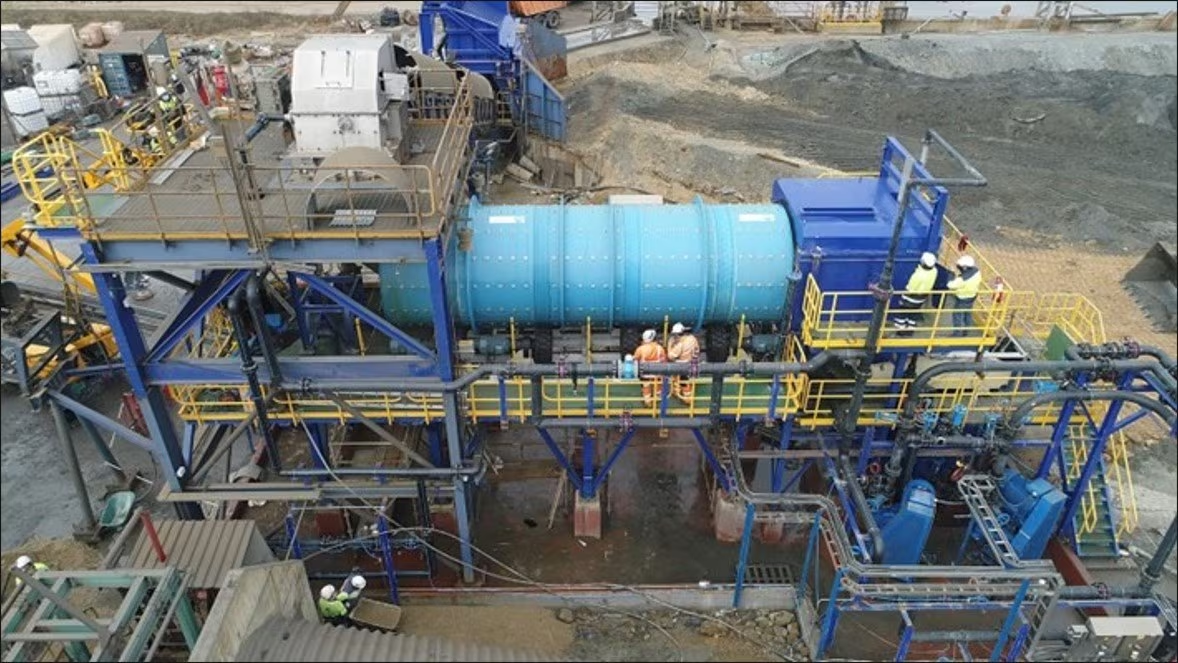
HYDROMETALLURGICAL TECHNOLOGIES FOR METALS EXTRACTION
RioTinto Proyectos y Desarrollos, S.L. (RTP) team has more than 40 years of accumulated experience developing new technological solutions and specific applications for the most prestigious companies in the mining and metallurgical sector worldwide, with the goal of extracting valuable metals from primary and secondary minerals, and recycled materials.
Each project, each customer, requires specific solutions tailored to their needs. Therefore, extensive knowledge and expertise in the most advanced techniques, equipment, and systems are essential to providing our clients with the most suitable and efficient solutions. In this regard, the RTP team designs, adapts, and implements the required process stages for its diverse projects, with the ultimate goal of optimised integration.
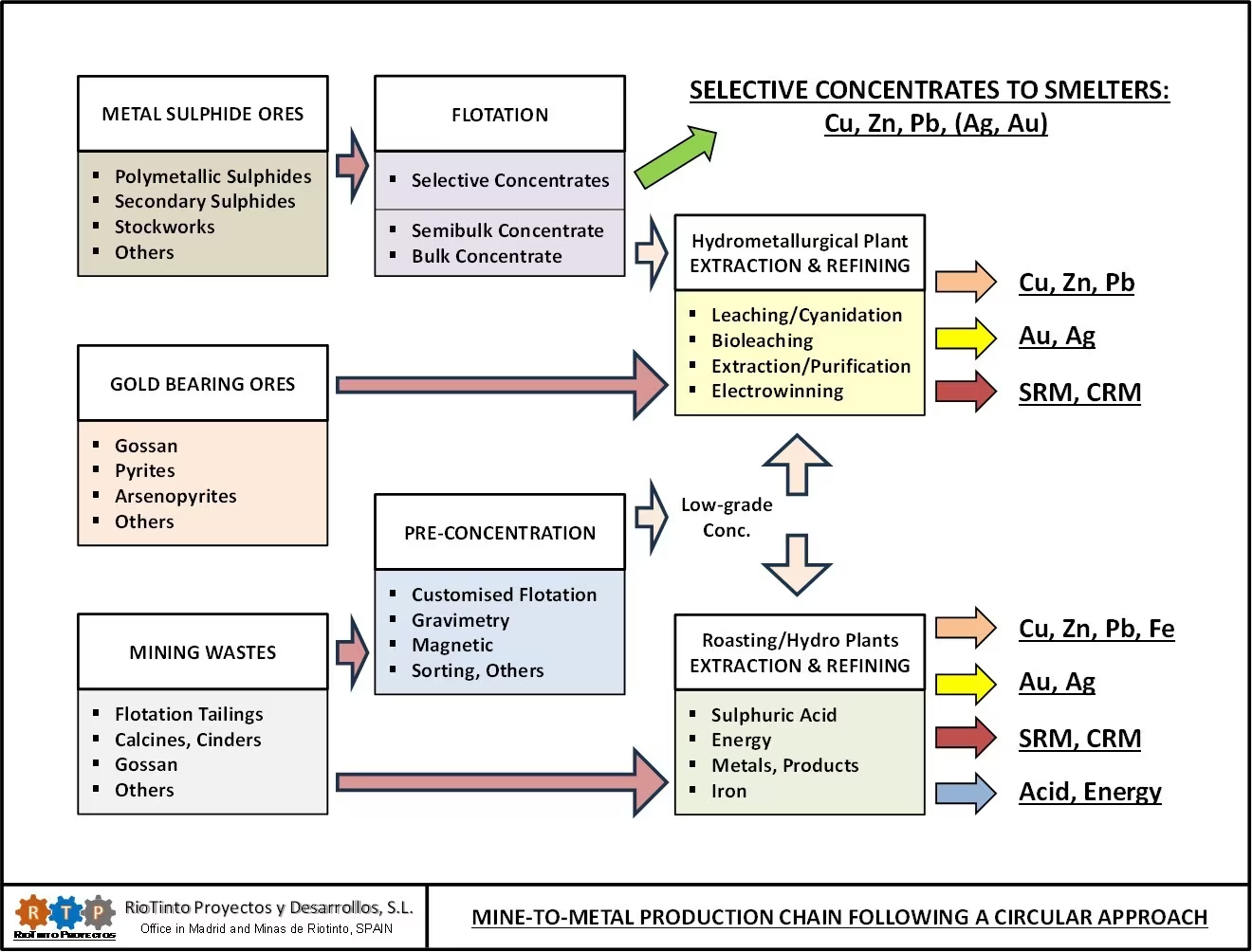
The following is a conceptual scheme showing the different stages and processes needed in the production chain from the ore that comes out of the mine to obtaining the final products and/or refined metals, applying the “MINE-TO-METAL” concept. RTP team designs or develops and adapts the required techniques, equipment and systems to each particular project.
The “MINE-TO-METAL" production chain following a CIRCULAR approach shifts from the traditional linear "take-make-dispose" model to a restorative system. It focuses on maximising the value of materials at every stage, minimizing waste by turning it into resources as much as possible, and integrating primary production with recycling. This holistic approach spans from mining to smelting, refining, and eventual recycling, often referred to as "circular mining-metallurgy".
FLOTATION OF METAL SULPHIDES
Selective flotation separates individual sulphide minerals into commercial concentrates of Cu, Zn, Pb, etc., which are treated in conventional smelters, usually far from the mine. Selective flotation process requires precise knowledge of mineralogy, control of surface properties and operating conditions.
Bulk flotation floats all desired metals together into a single concentrate, maximising metals recovery and requiring a simple circuit and flotation reagent scheme. There is no market for treating bulk concentrates, so its production is directly linked to their on-site treatment at the mine following the “MINE-TO-METAL” concept. The following table summarises the conditions associated with the process of selective flotation versus bulk flotation:
| CRITERION | SELECTIVE FLOTATION | BULK FLOTATION |
| Goal | Produce commercial concentrates | Maximise overall recovery |
| Circuit, reagents | Complex | Simple |
| Concentrate production | High grade, sacrificed recovery | Low grade, high recovery |
| Destination | Conventional smelters | Hydro processing in-situ |
| Detrimental elements | Subject to contract penalties | No limitations |
MINING WASTES PRE-CONCENTRATION. CIRCULAR ECONOMY
Pre-concentration of mining wastes (tailings and waste rock) prior to hydrometallurgical processing to recover valuable metals is a key strategy for enabling a Circular Economy model in the mining-metallurgical sector. By separating barren material (gangue) from valuable mineralised material early in the processing chain, this approach reduces waste volume, lowers processing costs, and minimises the environmental footprint. Used pre-concentration techniques are chosen based on the physical, chemical and mineralogical properties of the waste materials. Benefits prior to hydroprocessing include lowered reagent consumption, removing gangue reduces acid consumption in leaching, reduced comminution costs and increased productivity for increased throughput thanks to produce low-grade concentrate (reducing mass pull). Circular economy and valorisation of wastes enhances metal recovery (Reprocessing) and material re-use, converting tailings and wastes into construction materials (bricks, concrete aggregates) or used for underground backfill, reducing the need for new tailings dams. Moreover, pre-concentration reduces Acid Mine Drainage (AMD) potential by removing sulfidic material early, making the final waste more stable.
HYDROMETALLURGICAL PROCESSING OF BULK CONCENTRATES
Hydrometallurgical processing of bulk concentrates is a key enabler of the “MINE-TO-METAL" concept, allowing complex, low-grade, or mixed sulfide concentrates to be treated on-site, in the mine, producing finished products and refined metals rather than shipping commercial concentrates to distant smelters, which presents high environmental risks. This technological approach utilises aqueous chemistry -leaching, solution purification, and electrowinning- to efficiently recover valuable metals like copper, zinc, lead, nickel, cobalt, and critical and precious metals while reducing substantially environmental footprint.
Hydrometallurgical technologies following “MINE-TO-METAL” concept present the next advantages:
- Adaptable and modular from low throughput to medium and high plant capacities.
- Great flexibility against raw materials mineralogy, grade and contained impurities. Thus, Hydrometallurgy is suitable to deal with low-grade and dirty and polymetallic concentrates that cannot be treated in conventional smelters.
- Ability to design integrated flowsheets to recover, separate and purify SRM and CRM from primary and secondary mineral resources, producing in situ added-value metals and products ("commodities") aiming to enhance mining business profitability. This has a positive social impact in the local and national economies.
- Environmental footprint is minimised because it is not necessary to transport the concentrates to far locations, avoiding spillage and airborne emissions, and any generated waste is confined in the mine site and disposed of under most safer conditions.
Usually, Leaching is a key process stage to extract efficiently the valuable metals in an aqueous solution under required temperature and operating conditions. Most relevant Leaching Technologies include:
Sulphate media:
- Atmospheric Leaching
- Pressure Leaching
- Bioleaching
- Electro-assisted Leaching
Chloride media:
- Ferric Chloride Leaching
- Hot Brine Leaching
Less-conventional media:
- Alkaline, Ammonia, MSA
- Non-solvent Leachants
Cyanidation: Specifically for gold and silver extraction, the pre-treated material after base metal recovery is leached with cyanide to form soluble gold and silver complexes, which are then recovered via cementation (Merril Crowe) or adsorption on activated carbon. Main innovation RTP proposes is to test the use of reagents alternative to cyanide, which presents high toxicity.
COMBINED PYRO/HYDRO PROCESSING OF LOW-GRADE CONCENTRATES FROM TAILINGS
Flotation tailings often contain residual sulphides and strategic metals (Co, Ni, Cu, Zn, REEs, Au) that were not recovered in the primary circuit. In line with Circular Economy, reprocessing these tailings is considered a secondary resource strategy to meet rising demand for critical raw materials. Producing a low-grade concentrate via re-flotation or gravity/magnetic separation is typically the first step. Studies show that weathered tailings can yield concentrates enriched in Co, Ni, Cu, and Zn, suitable for further hydrometallurgical treatment.
Pyrometallurgical/hydrometallurgical treatment of low-grade concentrates from flotation tailings involves a multi-stage process that integrates pyrometallurgical techniques (typically roasting) with hydrometallurgical techniques to extract critical and strategic metals such as gold, silver, copper, zinc, cobalt, nickel, etc. This technological approach is essential for recovering the full value of sulfide minerals, including valuable metals, iron, acid, and energy, from low-grade concentrates produced from tailings that conventional methods cannot process effectively.
Concentrate roasting is a pyrometallurgical process used, on one side, to break down the refractory mineral structures in the concentrate, and other side, extracting full value of low-grade sulphide concentrates: metals, sulphuric acid and energy converted to electricity. Roasting modifies the mineralogy to improve metal liberation and leachability. Usually, Oxidative Roasting is applied to convert sulphdes (e.g., pyrite, pyrrhotite, chalcopyrite) into oxides or sulphates, sulphur content is minimised and opens mineral structures for further metal recovery.
Hydroprocessing of pyrite cinders. Pyrite cinders are typically rich in Fe oxides, with variable amounts of Cu, Zn, Pb, Co, and precious metals. Their complex mineralogy makes hydrometallurgical recovery challenging but feasible with optimised processes. Hydrometallurgical treatment of pyrite cinders generally refers to aqueous-phase extraction methods: acid leaching, purification, separation, metal winning, cyanidation, or other tailored processes to dissolve and recover valuable metals after pyrite has been roasted for sulphuric acid production and energy recovery.